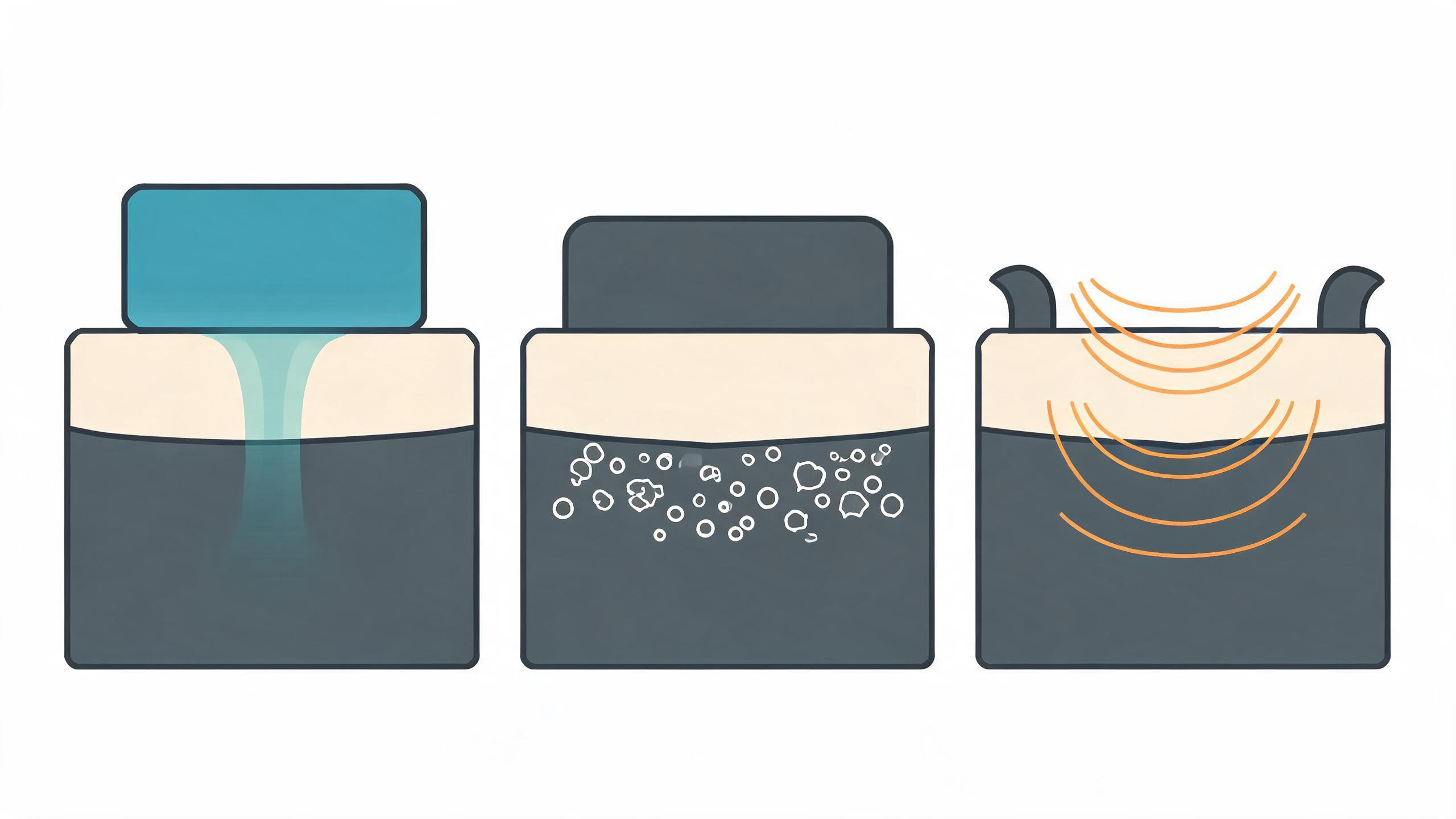
A body sculpting machine doesn't melt fat like a hair removal laser treats follicles, and that's the first thing to get straight. Say a clinic owner asks which platform she should stock for the patients who walk in wanting their abdomen flattened or their thighs tightened. The honest answer starts with physics, not brochures. Three energy routes sit under this category: controlled cooling (cryolipolysis), low-frequency ultrasound cavitation and radio frequency. Each one touches a different layer and produces a different endpoint. None of them treat obesity, and a spec sheet that hints otherwise should worry you. Our device manuals frame candidacy the same way: discrete, pinchable bulges on someone already near a stable weight, not global weight reduction. This page is a technical file for people specifying equipment. Once you read the parameter set behind each route, a long shortlist gets short fast.
The clinical approach
Cold works because subcutaneous fat cells crystallise at temperatures the dermis, nerves and vessels above them tolerate. Manstein and colleagues published the selective cryolysis basis in Lasers in Surgery and Medicine in 2008, demonstrating fat loss through intact skin. Four parameters carry a cryolipolysis cycle: setpoint temperature, dwell time, vacuum and applicator footprint. On our CR-01 platform the setpoint runs 0-15 °C in 1 °C steps, dwell time is adjustable 1-90 minutes, and vacuum is specified from -0.02 to -0.09 MPa at up to 140 L/min. Applicator footprint is the one buyers forget. A 165 × 81 mm cup and a 128 × 57 mm cup serve very different anatomy, and no software setting rescues you from the wrong handle.
Cavitation and RF are not the same job
Ultrasonic cavitation runs at 40 kHz, a low-frequency band that couples into hypodermal fat. Each cycle swings tissue between positive and negative pressure, forming and collapsing microscopic cavities until cell membranes give way and lipids emulsify. Radio frequency is different again. Bi-polar penetration is roughly half the gap between its electrodes: shallow, dermal, useful for tightening, with almost no fat-lysing effect. Mono-polar reaches deeper, heats more slowly, acts on the fat layer and needs a return pad under the patient. So if a vendor ships bi-polar tips only and still calls the machine a fat reduction system, ask for the penetration depth in millimetres. The answer, or the silence, tells you what you need.
Treatment protocol
Session structure follows the modality, not the brochure. Cold runs as cycles: one placement per area, typically 30 to 60 minutes of active cooling, with a repeat considered around the two-month mark. Cavitation is a course rather than an event, usually several sessions spread over weeks, often followed by an RF pass across the same field. Our device documentation starts vacuum-roller RF protocols at about 20 minutes per body area, 10 to 12 sessions in total, twice weekly for the first fortnight and then weekly. Read those protocol tables closely and you'll notice the parameter taper. On an abdomen, RF power steps down over the session while suction frequency steps up. That isn't arbitrary. It's thermal management.
What the published evidence supports
Ingargiola's systematic review in Plastic and Reconstructive Surgery (2015) pooled 19 studies of cryolipolysis and reported average fat layer reduction of 14.67% to 28.5% by caliper and 10.3% to 25.5% by ultrasound measurement. That range is the honest answer. A supplier quoting one flat dramatic figure is selling, not measuring. Photograph and measure your baselines properly, or the follow-up consultation turns into an argument about whether anything happened at all.
Screening and the paragraph nobody reads
Cavitation and RF are off the table for pacemakers and implanted electronics, epilepsy, kidney stones and serious cardiovascular disease. Cold is out for cold-related conditions such as cryoglobulinaemia or cold urticaria. Pregnancy rules out all three. Active infection or inflammation in the treatment field, same answer. One upside compared with light-based work: none of these methods target melanin, so Fitzpatrick type is rarely the limiting factor here. Separate the expected from the rare, because clients conflate them. Hedayati and colleagues reviewed 53 studies for Dermatologic Surgery (2020) and found the most common adverse events after cryolipolysis to be treatment-site erythema, numbness or paresthesia, bruising and edema, minimal in most reports and resolving quickly, with altered sensation in the treated fold the slowest to clear. Those belong in the consent conversation as expected reactions. The same review lists severe or persistent pain, dysesthesia, hyperpigmentation and motor neuropathy as the serious end, which is where counselling matters rather than reassurance.
One rare complication deserves a line in your consent form. Paradoxical adipose hyperplasia, where treated tissue enlarges instead of shrinking. Nikolis and Enright's multicentre review of 8,658 cycles in 2,114 patients (Aesthetic Surgery Journal, 2021) put the incidence at 0.15% per cycle and 0.43% per patient. Uncommon. Not zero. And it doesn't resolve on its own. Aftercare otherwise stays simple: water, movement, no shower for eight hours after vacuum-RF per our manuals, and transient erythema that our protocol notes typically settle within a few days. Everything on this page is technical information for equipment buyers; it isn't medical advice, and clinical decisions belong to the treating practitioner.
Recommended equipment
Matching the platform to the indication is where the money gets spent well or badly. Three machines cover the contouring menu, and most clinics need two of them at most. The CR-01 cryolipolysis platform handles cold work: discrete pinchable pockets where the goal is genuine fat-cell reduction in one or two visits. Four applicators in two sizes, 12.1-inch colour LCD, 1400 W maximum input draw, water plus air plus semiconductor cooling. Pick this when the client points at a specific bulge. The SM-01 cavitation and RF platform handles broad-area circumference work: thighs, waist, flanks. A 40 kHz cavitation head with a 72 mm tip at 50 W, paired with cooled RF at 2.64 MHz and up to 120 W in mono-polar and bi-polar modes. Compact chassis, so it rolls between rooms. The RF-01 skin tightening platform is the answer when laxity is the real complaint. It anchors our skin tightening workflow and pairs naturally with either of the above once volume comes down.
Boring section. Read it anyway.
Power. Built for 220 V or 110 V at 50/60 Hz, ±10%. If your local mains wanders outside that band, you need a regulator rated above 3 kVA, and that's on your quote. Room. 10-30 °C, 20-80% relative humidity, ventilated, out of direct sunlight. Water. The cryolipolysis platform is water-cooled. Roughly 1800 mL of distilled water at commissioning, a second fill after the first few minutes of running because the handles and radiator retain some, and a full change about monthly under heavy use. Run it dry and you'll be buying a semiconductor stack. Consumables. Antifreeze membranes and petrolatum for cold, coupling gel for ultrasound and RF. Cheap per session, but the membranes are a genuine recurring line, so price them before you quote ROI. Compliance. Medical electrical equipment in this class is designed against IEC 60601-1 for basic safety and essential performance, with the 60601-1-2 collateral covering electromagnetic disturbance. CE marking and your own national device registration are separate questions again. Ask for the file and confirm what your importer needs before the crate ships. Our service team handles commissioning and operator training; if you want the parameter tables and compliance documentation for a specific configuration, get in touch and we'll send them.
0-15 °C in 1 °C steps; 1-90 min; vacuum -0.02 to -0.09 MPa at up to 140 L/min; 165 × 81 mm and 128 × 57 mm cups
40 kHz; 50 W; 72 mm tip; RF 2.64 MHz up to 120 W
2.64 MHz; up to 120 W; mono-polar and bi-polar tips
Time per area
30-60 minutes of active cooling, unattended once the handle is placed
About 20 minutes per body area, hands-on
About 20 minutes per body area, hands-on
Course
One placement per area, repeat considered around two months
10-12 sessions, twice weekly for a fortnight then weekly
10-12 sessions, twice weekly for a fortnight then weekly
Return pad
No
Mono-polar only
Mono-polar only
Buyer checklist: what to verify before you commit
Confirm the indication you're buying for, and that the handpiece set actually covers it.
Confirm the clinical documents that come with the unit: user manual, parameter starting points, maintenance and troubleshooting section.
Confirm operator training and who performs the cold-sensitivity screen and consent.
Confirm the after-sales structure in writing before payment. Treat any certification, clearance, warranty length or price claim as something to verify directly with the supplier, because we don't publish those figures.
Frequently asked questions
Do body sculpting machines really work?
For the right candidate, yes, within limits. Published evidence supports measurable fat layer reduction after cryolipolysis, and the honest range is wide: Ingargiola's 2015 review in Plastic and Reconstructive Surgery pooled 19 studies and reported average reductions of 14.67% to 28.5% by caliper and 10.3% to 25.5% by ultrasound. Cavitation and RF work on different layers and give gentler, more gradual changes. None of them treat obesity, and none replace diet or exercise.
What is the best body sculpting device?
There's no single best; there's a best fit for the service you intend to sell. If clients point at one stubborn pocket, a cryolipolysis platform such as our CR-01 gives the clearest before-and-after in the fewest visits. If they describe general softness across the waist or thighs, cavitation plus RF on the SM-01 suits a course-based model. If laxity is the complaint, the RF-01 is the one you want. Buying both cryo and cavitation is common; buying everything on day one usually isn't necessary.
Can you do your own body sculpting at home?
No. These are clinical platforms with specific parameter ranges, screening requirements and contraindications. Cryolipolysis is contraindicated in cryoglobulinaemia, paroxysmal cold haemoglobinuria and cold agglutinin disease, and needs a cold-sensitivity screen before any applicator is placed. Cavitation and RF are off the table for pacemakers, epilepsy, kidney stones and serious cardiovascular disease. A home device can't safely replicate that, and the screening alone rules it out.
How many sessions of body sculpting are needed before results show?
It depends on the modality. Cold is often one placement per area, with a repeat considered around two months. Cavitation and vacuum-RF courses run 10 to 12 sessions, twice weekly for the first fortnight then weekly, about 20 minutes per body area. Fat clearance is gradual, so most clients see changes over weeks rather than after a single visit. Your device documentation will list the starting parameters; the treating practitioner decides the actual course.
Which body contouring machine should a new clinic buy first?
Start with whichever complaint walks through your door most. If clients point at one stubborn pocket, cryolipolysis gives the clearest before-and-after in the fewest visits and needs almost no operator time once the handle is placed. If they describe a general softness across the waist or thighs, cavitation plus RF suits a course-based service model and fills more appointment slots. A body contour machine is a platform, and each handpiece does a different job, so match the platform to your menu rather than to the number of handpieces on the cart.