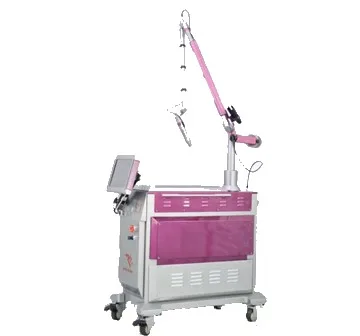
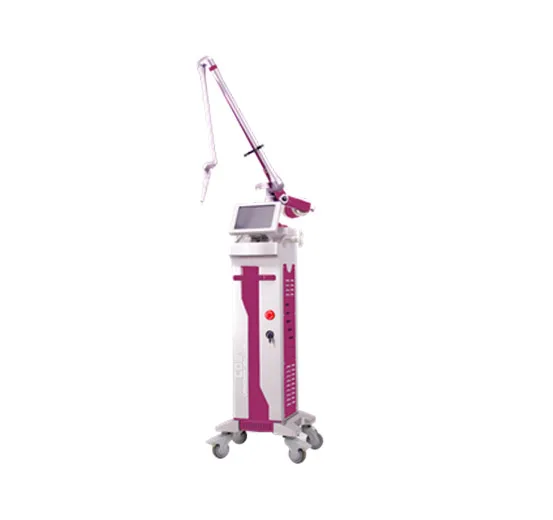
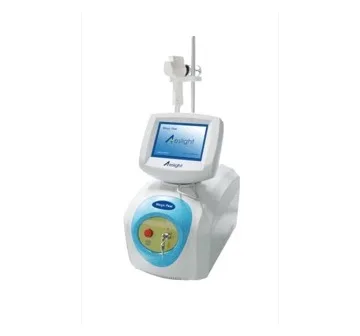
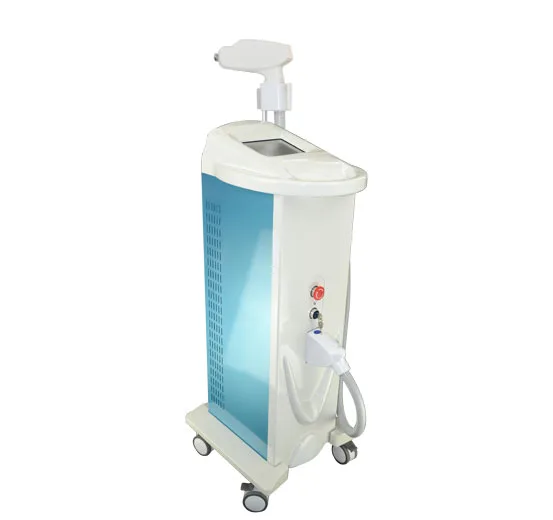
A tattoo removal laser machine lives or dies on one thing: whether the pulse is short enough to shatter ink instead of cooking skin. Say a clinic owner asks you which Q-switched Nd:YAG to put in room two. The QN-03 is our answer for routine ink and pigment work. It's built around a Q-switched Nd:YAG cavity, making it a q-switched nd yag laser tattoo removal machine for clinics that need dependable ink and pigment work. You get 1064 nm and 532 nm output, a 6 to 8 ns pulse width, and 400 mJ in single-pulse mode at 1064 nm. Double and triple pulse stack to roughly 800 mJ and 1200 mJ at 1064 nm. Seven spot sizes run from 1 to 4 mm. Cooling is water plus air. The whole console sits on a 52 kg floor-standing cabinet with a TFT touchscreen. That's the shape of it. The rest of this page is about which inks each wavelength actually clears, where the limits sit, and when the electro-optic QE-01 is the better buy. If you need vascular or hair work, neither machine applies.
The mechanism is selective photothermolysis, described by Anderson and Parrish in Science in 1983. Match the wavelength to the pigment. Keep the pulse shorter than the target's thermal relaxation time. The target takes the energy before heat spreads. Q-switching is what makes the pulse that short. Our technical documentation puts the numbers plainly: compress a few hundred microseconds of stored energy into roughly ten nanoseconds and peak power climbs by something like four or five orders of magnitude. Same joules. Different physics entirely. The pulse hits pigment as a photoacoustic shock. Particles fracture. Some exit through the epidermis. The rest break down small enough for phagocytes to carry off. The FDA's consumer guidance on tattoo removal describes the same clearance route, with fragmented pigment metabolised, excreted or ferried to lymph nodes.
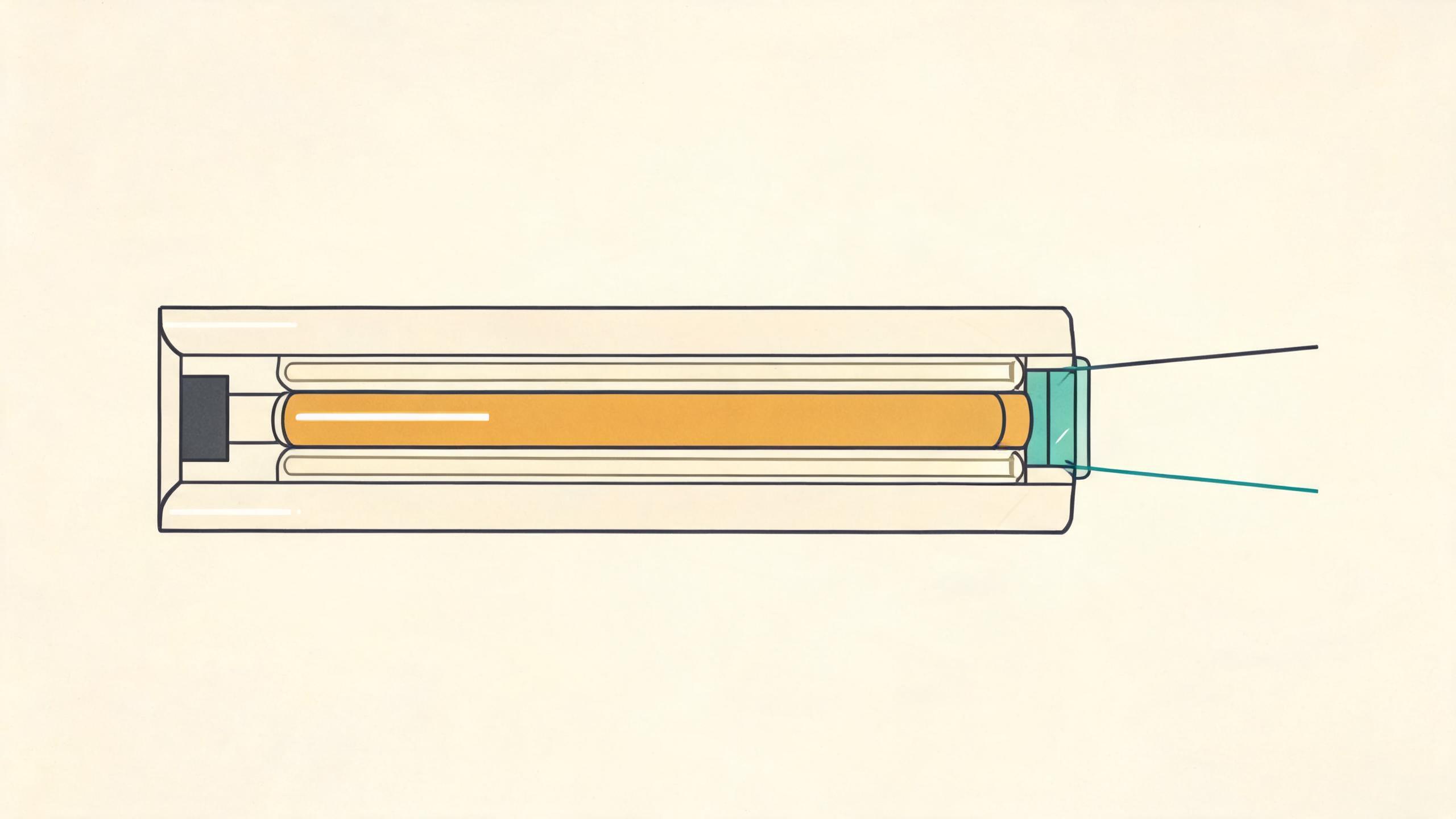
One structural detail explains a lot of the rest. Our device manuals record a single-flashlamp, twin-rod cavity, which is how this class reaches 400 mJ in a single pulse without an articulated arm carrying the beam. Fewer mirrors to align. Less to service later.
Fluence, not joules, is the number that bites
Push 400 mJ through a 2 mm spot and you're near 13 J/cm2. The identical 400 mJ through a 4 mm spot lands closer to 3 J/cm2. That's a factor of four from one click of the spot regulator. So any protocol you inherit is worthless unless the spot size travelled with it. Watch the ceiling too: ANSI Z136.1-2000 puts the maximum permissible exposure for nanosecond pulses at roughly 20 mJ/cm2 at 532 nm and 100 mJ/cm2 at 1064 nm, which is why eyewear rated for both lines matters.
Applications
QN-03 handles tattoos in black, blue, brown and red, professional or amateur, plus cosmetic brow and eyeline pigment. Add epidermal and dermal pigmented lesions, and carbon peel rejuvenation using a carbon suspension as an artificial chromophore. Protocol notes for the biggest use cases sit on our tattoo removal and nevus of Ota pages, with lentigines covered under freckle removal. None of that is medical advice. Every parameter decision belongs to the trained clinician holding the handpiece.
How to split the two wavelengths in the room
The 1064 nm beam goes deep and is only weakly absorbed by epidermal melanin. That makes it the workhorse for dark ink and for darker skin. The 532 nm line, generated through a KTP crystal, is absorbed hard by superficial and red-toned pigment. Published work on nanosecond 1064/532 nm systems follows that split: 1064 nm for black and blue, 532 nm for coloured ink. Wavelength is chosen per treatment area, not per client. One client can need both in a single visit.
What we honestly cannot clear well
Green, light blue and some pastel or cosmetic inks respond poorly to 1064/532 nm. That's a property of the wavelengths, not of this box. A double-centre retrospective study in Life treated black and blue tattoos at 1064 nm with fluence up to 10 J/cm2 and coloured tattoos at 532 nm up to 5 J/cm2, with at least eight weeks between sessions. Yellow, green and red clear harder. Say that out loud during consultation, and you'll get fewer angry phone calls in month three. Atypical lesions go to a dermatologist for assessment or biopsy before a laser touches them.
Key advantages
What changes for a clinic is mostly admin. No articulated arm means no arm alignment, no arm repair bill, and one less thing to damage in shipping. Water and air cooling keeps the cavity stable through back-to-back sessions. Consumables stay modest: distilled water, filters, and the flashlamp as a wear part. Our service team supplies manuals, remote operator training and spares through service, covering startup, water maintenance, parameter logic and fault codes. The built-in self-check makes phone diagnosis far quicker when something misbehaves.
QN-03 or QE-01: the question distributors ask most
QN-03 uses a passive Q-switch. Turn the energy up and the system adds pulses to the train rather than raising the peak power of one pulse. That's exactly why the spec reads 400, 800 and 1200 mJ for single, double and triple pulse. The QE-01 uses an electro-optic Q-switch, where applied voltage modulates a single pulse and single-pulse energy genuinely scales. Heavy caseloads of dense professional ink and dermal lesions earn the electro-optic route. For a clinic that wants one dependable laser machine for tattoo removal covering general pigment and ink work at a sane capital cost, QN-03 is the sensible box.
What you're comparing
QN-03
QE-01
Switching architecture
Passive Q-switch
Electro-optic Q-switch
Wavelength family
1064 / 532 nm Nd:YAG
1064 / 532 nm Nd:YAG
How energy scales
Pulses stack in the train (400 / 800 / 1200 mJ at 1064 nm)
Single-pulse energy scales with applied voltage
Best fit
General ink and pigment work, mixed caseload
Dense professional ink, dermal lesions, higher volume
Not for
Vascular or hair work
Vascular or hair work
Where this platform stops
We don't supply picosecond lasers, alexandrite lasers, erbium YAG (2940nm) lasers, electrolysis or microdermabrasion. Those are separate categories from other suppliers. If your caseload is mostly green and light blue ink, a picosecond platform deserves a look. If you need vascular or hair work, that's the LN-01 long-pulse platform. Choose honestly at the buying stage and you won't be apologising at the treatment couch.
Buyer Checklist Before You Order a Tattoo Removal Laser Machine
Before you commit to any tattoo removal laser machine, work through the same list with every supplier. Confirm the wavelength set, pulse width, single-pulse energy, spot size range and cooling method against your caseload. Ask what documentation ships in the crate, who trains your operators, how spares are supplied and what the consumables cost over time. Request the type-test report against IEC 60601-2-22. Check that the eyewear is rated for both 1064 and 532 nm at the correct optical density. Finally, meter the output at the handpiece if you can. A supplier who answers all of that in writing is a supplier worth shortlisting.
What is the most effective laser tattoo removal machine?
There isn't one machine that clears every ink. The Q-switched ruby (694 nm), Q-switched Nd:YAG (532 and 1064 nm) and Q-switched alexandrite (755 nm) are the three types currently used. Since many wavelengths are needed for multicoloured tattoos, no single system removes every ink and ink combination. A 1064/532 nm Q-switched Nd:YAG covers black, blue and red well, which is most tattoos in most clinics. Green, light blue and pastel inks are the weak spot. Match the platform to the caseload you actually expect rather than the brochure.
What qualifications do you need to do laser tattoo removal?
That depends entirely on your market, and we can't answer it for you. In most countries the device must be operated by a trained, licensed practitioner working under local rules. Some jurisdictions require a medical director or a specific laser safety course. Before you buy, ask the supplier what operator training they provide and what documentation ships with the unit. Then check the current requirements with your own regulator, because they change and they differ by region. Our remote training covers startup, water maintenance, parameter logic and fault codes, but it isn't a substitute for whatever your regulator demands.
How much does a tattoo removal laser machine cost?
We don't quote figures here. You should be wary of anyone who does without knowing your configuration. Price depends on the technology tier: a passive Q-switched Nd:YAG like the QN-03 sits in a different bracket from an electro-optic unit. Spot size options, handpieces and spares all move the number. Send any supplier the same written specification and ask them to price that, not a headline. Ask about spare parts, handpiece availability and consumables too, since the running cost over five years often outweighs the difference at purchase.
Should I buy a Q-switched Nd:YAG or a picosecond tattoo removal machine?
We don't supply picosecond lasers, so treat this as a category comparison. The general industry position is that picosecond pulses fragment ink into smaller particles and are often associated with fewer sessions. Where a nanosecond Q-switched machine still fits: clinics and med spas treating dark inks, pigment and skin tone work at a lower equipment entry point. If your caseload is heavy on green, light blue or stubborn multicoloured pieces, look at picosecond from a supplier who makes one. If it's mostly black, blue and red ink with some pigment work alongside, a Q-switched Nd:YAG does the job.
What should I ask any supplier before ordering a laser machine for tattoo removal?
Send the same list to every supplier and compare the answers in writing. Wavelength set, pulse width, single-pulse energy, spot size range, cooling method, and what documentation ships in the crate. Then the operational questions: who trains my operators, how do I get spares, what are the consumables, and who fixes it when it faults. Ask for the type-test report against IEC 60601-2-22. Confirm the eyewear supplied is rated for both 1064 and 532 nm at the correct optical density. Finally, meter the output at the handpiece if you can. Thirty seconds with an energy meter tells you more than any datasheet.