How it works
Why 1064 nm reaches deep
Scattering weakens as wavelength grows. Our technical documentation places 600-1200 nm in the optical window of skin: light in that band scatters less on the way down and gets intercepted less by everyday pigment, so a useful fraction still arrives at follicular structures in the dermis. 1064 nm sits near the far edge of that window. Epidermal melanin absorbs comparatively little there. That single fact is why this wavelength keeps getting specified for darker phototypes rather than a shorter, punchier one.
The absorbers that matter are hemoglobin and follicular melanin. Our engineering archive on light-tissue interaction records a detail worth knowing at the console: methemoglobin, which forms as blood heats, absorbs 1064 nm far more strongly than deoxyhemoglobin does. Vessel work is partly self-reinforcing, because the first pulses change the chromophore you are aiming at.
Pulse width is the whole argument
Thermal relaxation time is roughly how long a structure needs to shed about 63% of the heat it absorbed. Hair adds a second clock. Thermal damage time runs longer than TRT, since heat has to travel out from the shaft and matrix that actually absorb the light to the follicular structures you want destroyed. Our training material gives the classic contrast: a pigmented follicle coagulating around a 100 ms exposure, with epidermis at comparable energy density taking damage at about 99 ms. That's exactly why surface cooling is structural equipment here, not a comfort feature.
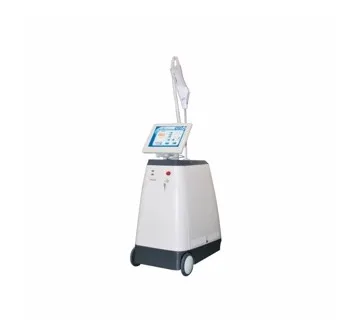
The LN-01 hands you 10 ms per pulse, one to ten pulses, and 1-10 ms of delay between them: long exposures get built by stacking, not by one enormous shot. Published practice runs longer than a single LN-01 pulse. Tanzi and Alster's 2004 study in Dermatologic Surgery treated 36 patients across types I-VI with long-pulsed 1064 nm at 30-60 J/cm² through a 10 mm spot, using 10, 20 and 30 ms for types I/II, III/IV and V/VI respectively, and reported side effects that were limited and transient. Against the spec table: the LN-01's single-pulse ceiling is 10 ms, so the 20 and 30 ms values in that study are not settings you can dial here. The route this machine offers is the train above, up to 10 pulses spaced 1-10 ms apart, lengthening effective exposure time. A train is not thermally equivalent to one 30 ms pulse, though: heat sheds during the intervals, so epidermal loading and dermal heat accumulation follow different curves. Parameters for types V and VI therefore have to be re-established on this machine by the treating physician, not copied across from the paper.
Fluence and spot arithmetic
Energy density is energy divided by spot area, so spot choice moves your power demand quickly. A 6.5 mm spot covers roughly 0.33 cm², so asking for 60 J/cm² there means putting out something near 20 J. Step down to the 4 mm spot and the same fluence costs far less energy, but you cover under 40% of the skin per placement and your session runs longer. The 360 J/cm² on the datasheet is a headroom figure. Nobody should be dialing it for routine work.