A tattoo removal machine gets judged on four numbers, and price isn't one of them. Wavelength, pulse width, spot size, energy per shot. Everything a clinic argues about later, from session counts to ink that won't shift, traces back to those four and to whoever holds the handpiece. Say a clinic owner asks which unit belongs in a room that already runs hair removal and skin tightening. Fair question. The harder one is what has to be in writing before anyone signs. Read what follows as a technical file for buyers, not as patient education. It assumes a licensed operator and a device kept in calibration. None of it is medical advice, and any lesion inside the treatment field you can't identify with confidence goes to a dermatologist first. Two platforms in our catalogue are built for ink, and they part ways in how the pulse gets made. That difference decides the room.
The clinical approach
What a tattoo removal laser does to ink
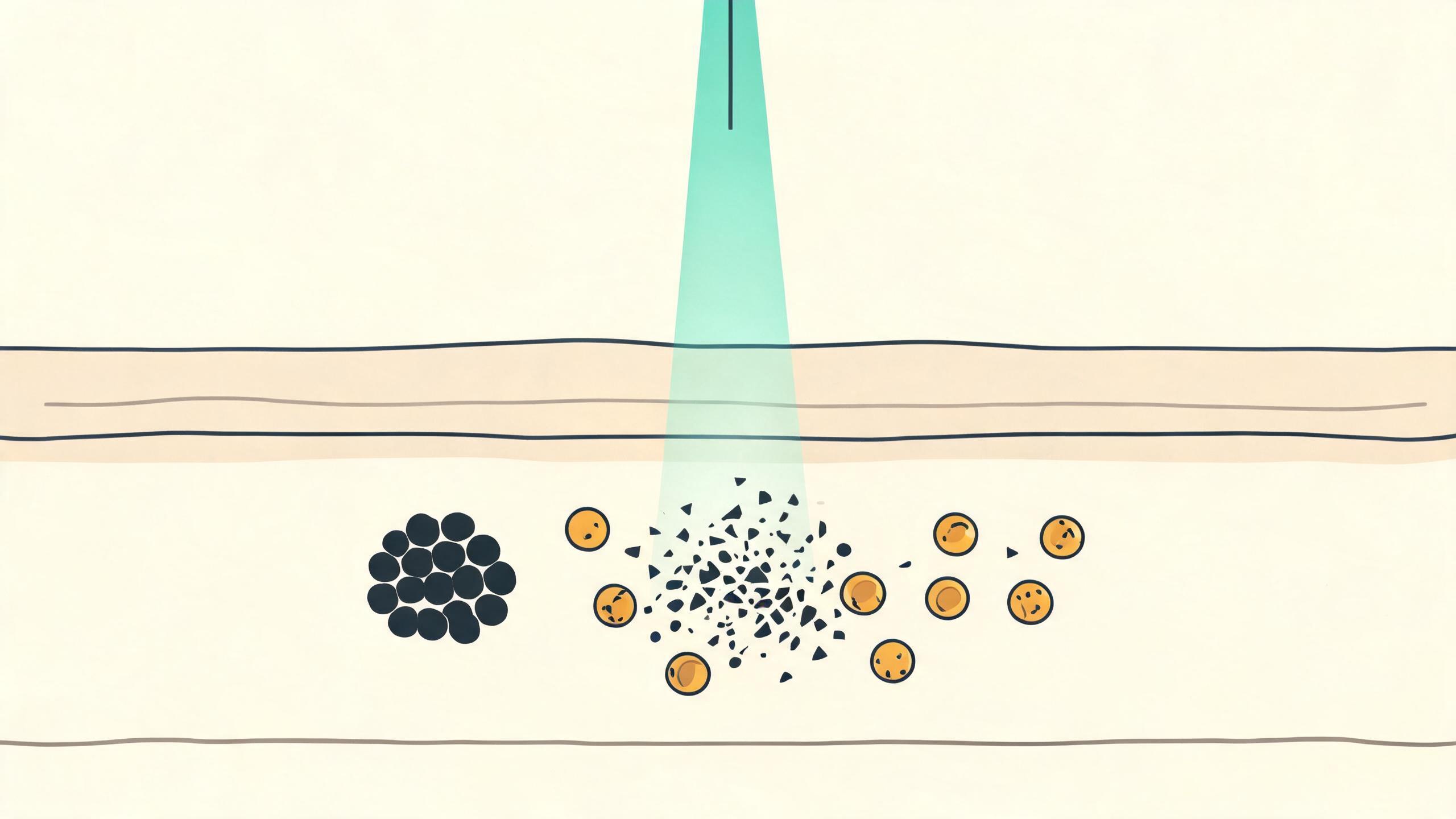
Ink isn't a stain you bleach out. It's granular pigment parked in the dermis, much of it locked inside macrophages, in particles far too large for the body to clear on its own. Warming it does nothing. Fracturing it does. That principle has a name, selective photothermolysis, and Anderson and Parrish set it out in Science in 1983. Match the wavelength to the target. Keep the pulse shorter than the time that target needs to shed its heat. The target takes enough energy to break while the tissue around it stays comparatively cool.
Q-switching is the hardware trick that drags a Nd:YAG pulse into that window. Our device documentation puts it plainly: take the energy a free-running rod would spill over hundreds of microseconds, squeeze it into single-digit nanoseconds, and peak power climbs by orders of magnitude while the joules never move. The particle gets a shock, not a bake. FDA consumer guidance describes what follows. Fragments are metabolised, excreted, or carried off to lymph nodes and other tissue.
So wavelength and pulse duration decide which inks respond. Not watts. A figure on a brochure with no pulse width beside it tells you very little.
Wavelength by ink colour, and the families we don't carry
There's no single machine to remove tattoo ink of every colour, and any supplier who says otherwise is selling you a wavelength list you should ask to see in writing. Our device manuals map it without ceremony. 1064 nm takes black, blue and green-blue. 532 nm takes red, orange and rose. Run both and you cover coffee and brown. That pairing isn't brochure symmetry, it's absorption. Longer wavelengths scatter less and reach deeper, which is why dense black ink sitting low is a 1064 nm job, and why 1064 nm is the more forgiving line on melanin-rich skin.
Green is the awkward one. The published position is that Q-switched 1064 nm and 532 nm systems plus the 694 nm ruby laser handle green inks, with 532 nm the pick for reds, oranges and roses (review). Ruby we don't have. Nor alexandrite, nor picosecond, nor erbium YAG at 2940 nm, nor electrolysis, microdermabrasion or skin analysers. Those categories sit outside our catalogue, and we'd rather say so at the start of a conversation than three quotes later.
Wavelength
Inks it takes
What to expect
1064 nm
Black, dark blue, green-blue
Deepest reach, kindest to melanin-rich skin
532 nm
Red, orange, rose
Shallower, competes with epidermal melanin
1064 nm + 532 nm
Coffee, brown, mixed amateur work
Two passes, two settings, one appointment
694 nm ruby
Green
Not supplied by us. Source elsewhere
Any platform
White and pale yellow, many built on titanium dioxide
Resistant end. Warn the client early
Treatment protocol
Sessions, and the gap that does the work
FDA consumer guidance puts typical laser removal at 6 to 10 treatments and says outright that green, red and yellow are the stubborn colours while blue and black cooperate (FDA). A 2021 double-centre retrospective by Cannarozzo and colleagues in the journal Life followed 52 patients on a 6 ns 1064/532 nm system, with fluence up to 10 J/cm² for black and blue ink and up to 5 J/cm² for coloured, and reported a mean of 4.6 sessions at a minimum eight-week interval (2021 series). Quote a range. Never a figure. That eight weeks isn't padding on the diary either. Shattered pigment has to be taken up by phagocytes and drained through the lymphatics, which takes weeks. Treat sooner and you stack trauma on skin that hasn't finished healing. You don't finish the course faster. You raise your complication rate.
Our device documentation's clinical report records tattoo removal at 1064 nm and 532 nm over 10 treatments, melasma at 1064 nm over 12, and solar lentigenes at 532 nm over 4. It's attributed to Dr Ben Chan MD, an aesthetic physician in Australia, and it describes Q-switched 1064/532 nm platforms as the standard approach to pigmented conditions, particularly on the face. Useful context at a consultation. Not a promise to hand a client.
What one visit looks like
Consult. Photograph. Write every parameter down, every setting, every pass, and get it signed. Clean the area and let it dry, because wet skin bleeds energy before it ever reaches the ink. Pick the wavelength for the pigment in front of you. Then test: our device documentation starts with 3 to 5 low-energy shots, watching how that patch answers, before you commit to a working setting.
Keep the tip perpendicular. Overlap spots by roughly a third. Stop when the pigment whitens and lightens. Obvious oozing means you've already gone past the endpoint. Fluence is energy divided by spot area, so the spot regulator moves that number faster than the energy dial ever will. Hold the energy still, double the spot diameter, and fluence falls by a factor of four. Any inherited parameter set tells you nothing unless the spot size came with it.
Depth follows the same logic. At one wavelength and one fluence, a larger spot penetrates further, which is why our device documentation pushes operators above 2 mm for dermal pigment and reserves sub-2 mm spots for junctional nevi and scars.
Aftercare and the effects list
Unglamorous, and it's most of the outcome. Keep the site dry and untouched for a couple of days. No picking at scabs. Strict sun protection until everything settles. Frosting, swelling and the odd blister are expected. Hyperpigmentation, hypopigmentation and scarring are the genuine risks, and they scale with careless fluence and with darker phototypes, where surrounding melanin competes for the same photons. Our notes on post-inflammatory hyperpigmentation go further into that. Patch test those patients. Every time.
Recommended equipment
QE-01 or QN-03, and what actually separates them
Both fire 1064 nm and 532 nm at nanosecond widths. Here's the split. The QE-01 runs an electro-optic Q-switch, a polarizer plus a voltage-driven crystal shutter inside the resonator, so pulse width stays pinned at 6 ns while you move energy up and down, and every trigger is one predictable shot. Our engineering archive records single-pulse output up to 800 mJ at 1064 nm, a continuously adjustable spot through a seven-joint articulated arm, 1 to 10 Hz, and a flat-top beam. The QE-01 spec sheet carries the full table.
The QN-03 is passive. 6 to 8 ns, 400 mJ single pulse at 1064 nm, with double and triple modes stacking toward roughly 800 and 1200 mJ. Seven fixed spot sizes, 1 to 5 Hz, and no articulated arm at all, so there's one fewer optical train to align and one fewer thing to pay for when it drifts. The rest sits on the QN-03 page.
Be clear about what multi-pulse buys you. More total energy per trigger, not more single-pulse peak power. That last figure is fixed by the design. A heavy daily ink caseload with continuous spot control argues for the electro-optic route. A mixed pigment clinic watching capital cost argues for the passive one.
QE-01
QN-03
Switching
Electro-optic, crystal shutter
Passive
Pulse width
6 ns, stable as energy changes
6 to 8 ns
Single pulse at 1064 nm
Up to 800 mJ
400 mJ
Multi-pulse
Single-shot output
Double and triple, roughly 800 and 1200 mJ
Spot
Continuously adjustable, 1 to 7 mm
Seven fixed sizes, 1 to 4 mm
Repetition rate
1 to 10 Hz
1 to 5 Hz
Beam delivery
Seven-joint articulated arm
No articulated arm
Weight
Around 45 kg before the arm
Not published
And the question that ends more sales calls than any other. If your business case needs picosecond pulses, rule us out now, because both of these are nanosecond. The published edge on clearance sits with picosecond in a randomised comparison of 1064 nm picosecond against Q-switched 1064 nm, reporting 78.1% versus 54.4% excellent clearance over a median of 3 versus 4 sessions (study). Those sources also cost considerably more to buy and to keep serviced. Nanosecond Q-switched Nd:YAG remains the mainstay for black and blue ink, for pigmented lesion work, and for any room where capital cost is the binding constraint.
Cooling, aiming beam and handpiece
Ask how the tip is cooled. Contact cooling through a chilled window is the usual clinic answer and it holds up across a long list. Air cooling sounds gentler and gets noisy in a small room. Ask whether the water loop is closed, because an open one means topping up and, sooner or later, a water-quality fault in the middle of a session.
Aiming beam alignment matters more than buyers expect. Small-lesion work on brows, lip lines and cosmetic pigment lives or dies on whether that dot sits where the beam actually lands, so check it on the unit in front of you rather than in a photograph. According to our device documentation, the accessory set shipped with the Q-switched Nd:YAG unit includes the articulated arm, a spot adjustor, the foot pedal, an interlock shorting stub, keys, protective eyewear and CPC heads. Confirm any eyewear covers 200 to 1080 nm, since 532 nm is visible green light and perfectly capable of taking a retina with it. On delivery method, an arm gives reach and keeps the beam path in air, and it wants occasional alignment. A fibre is tidier and adds a part you'll replace one day. Neither is wrong. Match it to the room.
What the quotation must itemise before you order
Any laser tattoo removal machine for sale should arrive with a document, not a sentence. Ranking pages tend to jump from theory to a checkout button and skip this part. Ours doesn't.
Every handpiece and spot tip in the box, and whether a spare set is included.
Aiming beam type, and how it's aligned and checked.
Cooling method, and whether the water loop is closed or needs topping up.
The spare-parts list and the consumables list, written out, with the wear items named.
The named service path: who you contact, through whom, and what happens out of hours.
What's excluded. Installation, operator training, freight terms, duties and customs clearance are easy to leave off a quote and hard to argue about afterwards.
Whichever supplier you're talking to, ask for the laser product classification file against IEC 60825-1 and the type-test report against IEC 60601-2-22.
Then check the unit itself rather than the datasheet. Key switch, remote interlock, emergency stop, foot pedal. Borrow an energy meter if you can and read the output at the handpiece. Thirty seconds there beats any brochure. After that comes the mundane half: purified water fill, a full water change every couple of months, the flashlamp as a wear part, a spare fuse in the power socket, a dry temperate room with no reflective surfaces near the beam path. Metal jewellery comes off the patient.
Pmise supplies professional aesthetic laser and energy-based equipment to clinics, medspas and distributors, and runs its own service team for manuals, spares and remote operator training. Tell us your market and we'll tell you which documentation applies there. Compare full tables across the catalogue before you spec the room.
Frequently asked questions
What makes one tattoo removal machine more effective than another?
Wavelength match first, then pulse duration, then consistency of the spot, and finally the operator. A 1064 nm line clears black and dark blue. 532 nm clears red, orange and rose. Nanosecond Q-switched pulses fragment the particle instead of heating it, and a flat-top beam delivers even energy across the spot so results don't drift pass to pass. Ask any supplier for wavelength, pulse width and spot size together on one page. Then ask which wavelength families they carry, because ours doesn't include the 694 nm ruby platform that published work points to for green ink.
Do home tattoo removal machines work?
They're a different device category, and the comparison flatters them. Our catalogue is clinic equipment, supplied to clinics, medspas and distributors, and it assumes a trained, licensed operator working from a written protocol. Nothing handheld or consumer-facing sits in it. If a client asks whether to try one, send them to the FDA's consumer guidance, which sets out what professional removal involves, and leave the advice there.
How much does a tattoo removal machine cost?
There's no price on this page and we don't publish one, because the figure depends on the cavity type, the accessories, the spares package, training and what the freight terms actually cover. Anyone quoting a headline number before asking about your caseload is guessing. Ask for a full itemisation instead: handpieces, spot tips, aiming beam, cooling, spare-parts list, consumables, service path, and what's excluded. Then compare two suppliers on the same sheet.
How many sessions should I quote a client?
A range, with the caveats attached. FDA guidance says 6 to 10 treatments is typical, and the 2021 Life series averaged 4.6 on a nanosecond 1064/532 nm platform. Ink density, depth, age, body site and the client's own clearance rate all move that. Amateur work generally goes faster than a saturated professional piece. Say so at consultation, not after the fourth visit.
Do you supply picosecond, alexandrite or erbium YAG lasers?
No. Our platforms here are nanosecond Q-switched Nd:YAG, the QE-01 and the QN-03. Alexandrite, picosecond, erbium YAG at 2940 nm, electrolysis, microdermabrasion and skin analysers aren't ours to sell, and we'll say that on the first call rather than the third. Picosecond holds the published edge on clearance in a randomised comparison of 1064 nm picosecond against Q-switched 1064 nm, reporting 78.1% versus 54.4% excellent clearance over a median of 3 versus 4 sessions, and those devices cost considerably more to acquire and to service. If picosecond is your requirement, rule us out early.