How it works
Why the 6 ns matters more than the joules
Take a pulse of fixed energy and squeeze it from the microsecond range down into nanoseconds. The energy hasn't changed. Peak power has, by roughly four orders of magnitude, and that is the whole trick our engineering archive uses when it explains Q-switching to new engineers. Pigment absorbs the burst faster than heat can leak into surrounding dermis, so the particle fractures photoacoustically instead of cooking its neighbourhood. Anderson and Parrish named the principle selective photothermolysis in Science in 1983, and nanosecond pigment devices still stand on it.
What follows is biology, not bleaching. Some fragments leave through the skin surface. The rest get engulfed by phagocytes and drained through the lymphatic system over the following weeks, which is precisely why sessions are spaced rather than stacked.
Wavelength, spot size and fluence are one decision
1064 nm penetrates deeper and is absorbed only weakly by epidermal melanin, so it takes dermal pigment and dark ink. 532 nm goes after red tones and shallow marks. Use both and you cover coffee and brown shades. Fluence is energy divided by spot area, which means a smaller spot raises fluence but costs you depth; our device manuals push operators to stay above 2 mm for dermal pigment and reserve sub-2 mm spots for junctional nevi and scars. Fire 3 to 5 low-energy test shots, watch how the area answers, then commit to a setting.
Applications
What this platform is actually for
- Multicolour tattoos: black, blue and green-blue ink at 1064 nm, red at 532 nm, coffee and brown shades with both wavelengths
- Dermal pigment: nevus of Ota and Ito, Mongolian spots, CALMs, zygomatic lesions
- Epidermal marks: sunspots, age spots, freckles
- Low-fluence toning passes for dull, uneven tone, including cautious melasma protocols
Where the boundary sits
Our device manuals rule out pacemakers and implanted defibrillators, pregnancy, severe diabetes, uncontrolled hypertension, cardiac disease and epilepsy, active herpes or malignant lesions in the field, broken skin, and vascular surgery on the area within the past two months. Keloid-prone patients are a poor fit. Melasma deserves its own restraint, since too much fluence provokes post-inflammatory hyperpigmentation instead of clearing anything. Any lesion you can't confidently identify goes for biopsy or dermatology referral before a single shot. US FDA consumer guidance is blunt on the point that tattoo lasers are cleared for use by, or under the supervision of, a health care professional.
One failure mode earns its own line. White, flesh-toned and pink inks, and the cosmetic tattoo pigments used for brow, lip and eyeliner work, commonly carry titanium dioxide or iron oxide; a nanosecond pulse can chemically reduce them so the mark turns grey or black immediately, and darkened ink is harder to clear than what you started with. Anderson and colleagues reported this in Archives of Dermatology in 1993 and concluded that patients should be warned of potentially irreversible darkening and that test-site exposures should be done first. So treat any such ink with a single concealed test point, read the immediate response, and never open with a full pass across a light-coloured area.
Key advantages
QE-01 against the other Nd:YAG platforms on this site
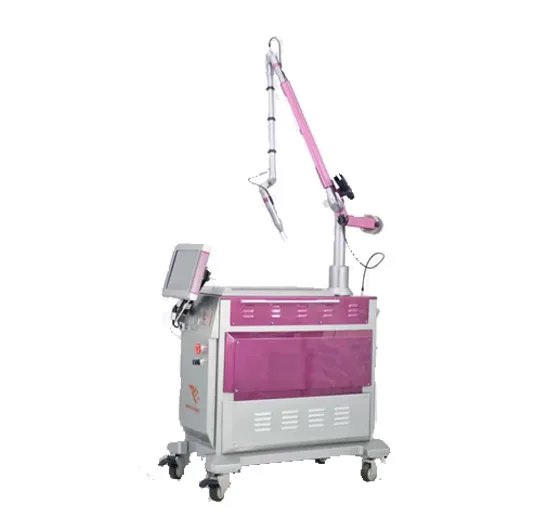
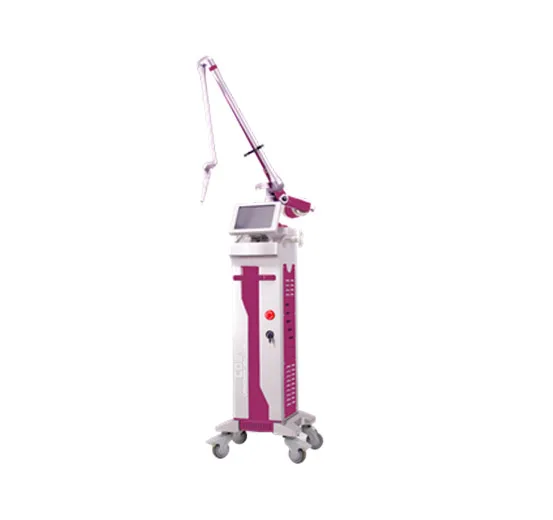
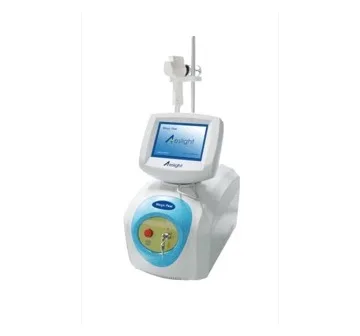
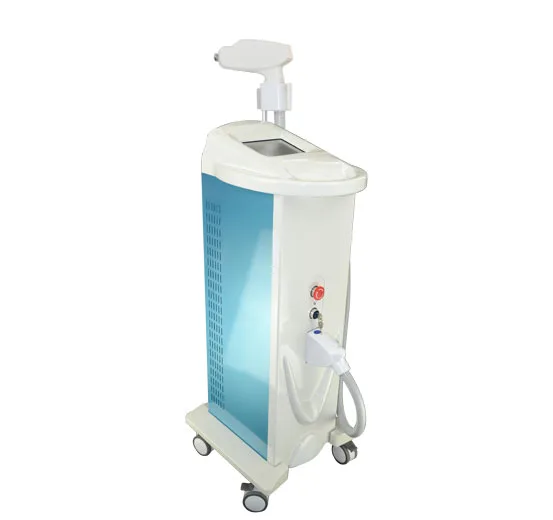
Three machines here emit 1064 nm and they are not interchangeable. The QE-01 gives you a locked 6 ns pulse, a continuously adjustable 1-7 mm spot delivered through a 7-joint articulated arm, and up to 800 mJ at 1064 nm or 400 mJ at 532 nm. The QN-03 gets to comparable energy by stacking double and triple pulses, offers fixed optional spot sizes from 1 to 4 mm, runs 1-5 Hz and drops the arm entirely, which pulls down both price and maintenance. The LN-01 isn't a pigment shatterer at all; millisecond pulses heat a target rather than fracture it. Heavier throughput and arm-guided spot control argue for the QE-01. A tighter budget and a lighter caseload argue for the QN-03.
Acceptance checks, safety and consumables
Ask for IEC 60825-1 classification documentation and the CE file before the crate ships, then confirm the eyewear really covers 200 to 1080 nm. Green 532 nm light is visible and still dangerous to look at. The rest is mundane engineering reality: flat-top beam, water plus air cooling, about 1.8 litres of purified water at first fill, a full water change every two months, a spare 250 V / 10 A fuse sitting in the power socket, 65 kg net on castors, AC 220 V 50 Hz or 110 V 60 Hz at max 10 A. Our service team covers parts and remote operator training.
Specification
| Laser Type | Q-switched Nd:YAG laser |
|---|
| Maximum Energy | 800mj-1064nm; 400mj-532nm |
|---|
| Frequency | 1-10Hz |
|---|
| Beam Delivery | 7-joint Arm |
|---|
| Wavelength | 1064nm, 532nm |
|---|
| Pulse Width | 6ns |
|---|
| Spot Diameter | 1-7mm continuously adjustable |
|---|
| Power Supply | AC 220V 50Hz;AC 110V 60Hz |
|---|
| Insurance Standard | Max 10A |
|---|
| Net Weight | 65kg |
|---|
| Gross Weight | 84kg |
|---|
| Dimensions (after package) | 83x52.5x107cm3 |
|---|
Frequently asked questions
What does EO Q-switching change day to day?
Energy control, mostly. In an electro-optic design, raising energy raises peak power inside one pulse whose width never moves. A passive Q-switch adds pulses instead. So on this machine a fluence setting maps to a single predictable shot, which helps when you document parameters case by case. If the multi-pulse approach suits your work better, look at the QN-03 .
How many sessions will a tattoo take?
No one can quote you a number honestly. Ink colour, density, depth, age and body site all move it, and a professional multicolour piece runs far longer than faded amateur work. Space visits several weeks apart so lymphatic clearance has time to finish. FDA consumer guidance also warns that removal can scar and may not clear a tattoo completely; tell patients that before the first session, not after the fourth. If the piece carries white, pink or flesh-toned infill anywhere, put a test point in first and read it before you quote a course at all.
Can I treat darker skin types with it?
1064 nm is the conservative wavelength, because epidermal melanin absorbs it weakly. Patch test anyway. Keep fluence modest, and be considerably more careful with 532 nm on higher Fitzpatrick types, where melanin uptake is strong. Judgement beats the spec sheet every time.
What do installation and upkeep involve?
Fill with purified water until it runs back out of the overflow port, then power-cycle the unit a few times so the loop primes properly. Keep the room between 10 and 40 degrees C with humidity under 75 percent, and keep treated skin dry, since wet skin bleeds off energy fast. Drain the water before shipping the machine anywhere. Manual, remote training and spare parts ship with it; ask us for warranty terms in your market.
References
- Anderson RR, Parrish JA. Selective photothermolysis: precise microsurgery by selective absorption of pulsed radiation. Science. 1983;220(4596):524-527.
- US FDA - Tattoo Removal: Options and Results (consumer update)
- Anderson RR, Geronemus R, Kilmer SL, Farinelli W, Fitzpatrick RE. Cosmetic tattoo ink darkening: a complication of Q-switched and pulsed-laser treatment. Arch Dermatol. 1993;129(8):1010-1014.
- IEC 60825-1:2014 - Safety of laser products - Part 1: Equipment classification and requirements (IEC Webstore)