How it works
Pulse structure is the control you actually tune
Selective photothermolysis is the governing idea: pick a spectral window your target absorbs better than the tissue around it, then deliver the energy faster than that target can shed heat. Our engineering archive defines thermal relaxation time as the interval a structure needs to release roughly 63% of the heat it absorbed. Small epidermal pigment sheds heat fast. A terminal follicle is bigger and slower, so it needs a longer, gentler delivery.
That's why PE-01 splits the shot. First-pulse width runs 0.1–25ms and does most of its work on superficial pigment and papillary-dermis vessels. Sub-pulses run 0.1–10ms each, with intervals up to 20ms so the epidermis can dump heat between them. Stack more sub-pulses and you push heat deeper while going easier on the surface — standard practice for hair work. Tighten the interval and narrow the pulse and you get the sharp, instantaneous heating that fragments epidermal pigment. Same machine. Completely different thermal event.
The filter decides the job, not the marketing name
The lamp is broadband. Every device-level filtration stage strips wavelengths below 400nm before anything reaches skin. After that the cut-off filter opens the window: 530–1200nm for rejuvenation and acne work, 585–1200nm for telangiectasia and diffuse redness, 610–1200nm for hair, with 560–1200nm and 430–1200nm available as options. The pattern is consistent across published IPL guidance and our own charts — melanin absorbs hardest at short wavelengths, so darker skin gets a longer cut-off that spares the epidermis, while a fair patient can safely take a shorter one. The StatPearls IPL review on NCBI Bookshelf lays out the same logic, and notes that pigmented lesions are often treated near 16–20 J/cm² rather than anywhere near a device's ceiling. Don't read a 50 J/cm² maximum as a target.
What the RF stage buys you
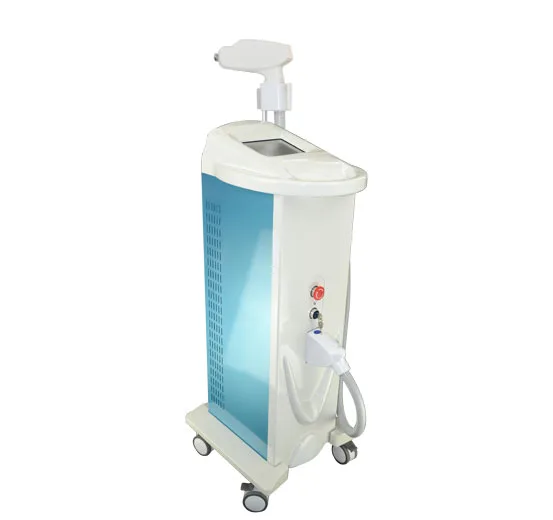
RF at 2.64MHz heats by agitating water molecules, so its depth depends on electrode geometry rather than chromophore. Three handpieces share that generator. F+E is the filter-changeable E-light head on the 40×8mm spot; F+E+ is the 60×15mm big-window head, where light and RF fire together or separately and most hair work happens; RW-V is the contact-cooled RF head, and it takes both electrode families — bi-polar tips at ø25mm and ø45mm, mono-polar tips at ø15mm, ø25mm and ø45mm.
Bi-polar and mono-polar are not the same treatment
The depth rule everyone quotes is a bi-polar rule. Our technical documentation puts bi-polar penetration at roughly half the distance between the two poles, which is why the ø25mm tip is the eye-area tip and ø45mm is the body tip. Mono-polar is a different circuit: current leaves the tip, crosses the body to a return pad, and spreads. Depth there comes from electrode area and power, not from any pole spacing — our archive records mono-polar as the slower, deeper, more volumetric mode, and the only one of the two with a real effect on the fat layer. The E-light handpieces fire light and RF from the same window, so the composite shot is bi-polar by construction; mono-polar belongs on the RW-V head when tightening alone is the goal. Either way, RF working mode switches between continuous and pulse, with RF time and delay each set from 1 to 20s.
The clinical payoff of the composite shot is documented: Yaghmai and colleagues reported in the Journal of Cosmetic Laser Therapy (2004) that pairing RF with pulsed light let them reach hair-reduction endpoints at lower optical fluence, which is what makes treating darker skin types more forgiving.